
Landing Page Optimization: The Ultimate Guide to Boost Conversions in 2026
Landing Page Optimization: The Ultimate Guide to Boost Conversions in 2026
Tamanna
March 22, 2026
SEO Training,Digital Marketing Tips
Tamanna
March 22, 2026
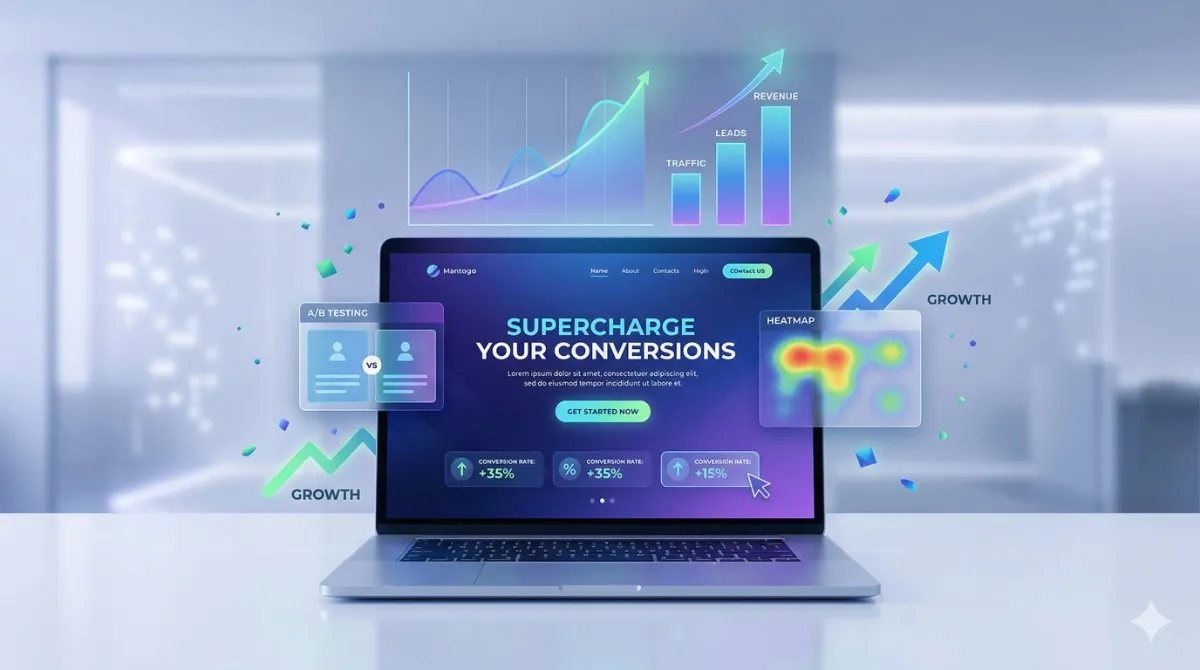
Landing pages are very important in digital marketing since they are made with a single objective in mind which is to transform the visitors into leads or customers. They do not divert attention, but get the user focused on a specific task as compared to other web pages and hence can be regarded as one of the best assets of presenting a result online. Well constructed landing pages align with the user intent and the message of the campaign, which increases the probability of conversion by a significant factor.
The landing page optimization is more crucial than ever in 2026. As competition mounts and the cost of advertising goes up, companies can no longer afford to just count the traffic, they have to work on the conversion of the traffic in an efficient manner. Launching landing pages is intended to enhance the user experience, respond to the evolving user behavior, and guarantee all visitors receive a smooth and meaningful experience.
The optimization effect can be seen in conversions and in return on investment (ROI) directly. Minor changes in design, content or layout can lead to a considerable improvement in the conversion rates and businesses will be able to earn more income with the same amount of traffic. It also minimises customer acquisition expenses and optimizes marketing campaigns resulting in landing pages being a real growth generator of any business online.
Landing page optimization (LPO) is the act of making a landing page work better, namely in terms of design, content and general user experience to get more people to perform a given action. This action may be in the form of registering in a service to purchasing or completing a form. This is in the hope of making the page more relevant, interesting and persuading to their users to have a higher probability of conversion.
Landing page optimization refers to a tactic of maximizing every aspect of a page such as headlines, images, design and call-to-action buttons to enhance performance. It does not require any assumptions; it uses the data, behavior of the user, and testing strategies to determine the most efficient and continue to enhance the page to obtain better results.
The optimization of landing pages is critical as it directly influences the level of the ability of your site to convert your visitors into customers. Regardless of the volume of traffic that you can create, unless your landing page is optimized, there is a likelihood that most of the users will not make the step.
With the better landing page, you will be able to provide better and easier experience leading to the conversion and will be able to achieve more effective outcomes of your marketing strategy.
Optimization of landing pages is mainly aimed at boosting conversion. Enhancing such aspects as headlines, content, and call-to-action buttons, you make it less difficult and more attractive to make users act.
Minor modifications (e.g. improved messages or the positioning of CTAs) can increase the rate of conversion dramatically.
An ugly landing page will drive away the visitors in a few seconds. When used correctly, optimization can make you more noticed at first glance and give you the relevant information that will keep the user interested.
With fewer cases of bouncing as the visitors encounter what they are seeking, they might tend to remain on the page and continue exploring.
The key factor of conversion success is the user experience. It is easy for users to interact with your page because of a clean layout, high loading speed, and easy navigation.
The simplified landing page makes your visitors more confident as well as more likely to take the desired action by making them feel confident and easy to use.
Optimization of the landing page assists in extracting more out of the existing traffic. You do not have to spend additional money on advertisement but enhance the performance of the already existing visitors.
An increased conversion rate ensures that you require fewer visitors to meet your objectives driving down the total cost of acquiring customers and improving profit margins.
The first thing is to have a profound knowledge of your audience to have a successful landing page. The most brilliant design and copy is not going to translate well unless you know who your visitors are and what they need.
Understanding your audience will help you create messages that are responsive to the problems of your audience and make them act. The more similar your landing page is to those of the user the higher the chances of making a conversion.
User intent refers to the reason why someone visits your landing page. Are they looking for information, comparing options, or ready to make a purchase?
By identifying intent, you can tailor your content and design accordingly. For example:
Matching your landing page with user intent ensures visitors find exactly what they’re looking for.
Pain points are the problems or challenges your audience is trying to solve. Understanding these helps you position your offer as the best solution.
Focus on:
When your landing page clearly addresses these issues, it builds trust and makes your offer more compelling.
User personas are detailed profiles that represent your ideal customers. They help you understand your audience on a deeper level and create more targeted landing pages.
A strong persona typically includes:
By using personas, you can craft personalized messaging that resonates with your audience and improves conversion rates.
Not all visitors who land on your page are ready to convert immediately. Each user is at a different stage of the buying journey, and your landing page should be optimized to match their intent.
Understanding the marketing funnel helps you deliver the right message at the right time, increasing engagement and conversions.
At the awareness stage, users are just discovering a problem or need. They are not ready to buy yet and are mainly looking for information.
Focus on:
Examples of content:
At this stage, your goal is to attract attention and build trust without pushing for immediate conversion.
In the consideration stage, users are evaluating different solutions. They are aware of their problem and are comparing options to find the best fit.
Focus on:
Examples of content:
Here, your landing page should build confidence and help users move closer to making a decision.
At the decision stage, users are ready to take action. They just need the final push to convert.
Focus on:
Examples of content:
At this stage, your landing page should remove any remaining doubts and make it easy for users to convert quickly.
In order to boost the performance of your landing page, you must use the established methods of optimization rather than a trial-and-error approach. These techniques will assist you in comprehending the behavior of users, discovering areas of trouble, and making data-driven solutions that will boost conversions.
A/B testing (also known as split testing) is one of the most effective ways to optimize a landing page. It involves creating two versions of the same page and testing them against each other to see which performs better.
You can test elements like:
By comparing results, you can identify what resonates most with your audience and make informed decisions to improve conversions.
Understanding how users interact with your landing page is essential for optimization. User behavior analysis helps you identify what works and what doesn’t.
Key insights include:
This data helps you spot problem areas and optimize your page for better engagement and performance.
Heatmaps provide a visual representation of user activity on your landing page. They show where users click, move their cursor, and spend the most time.
Types of heatmaps:
These insights help you understand which parts of your page attract attention and which areas are being ignored.
User feedback gives you direct insights into what visitors think about your landing page. It helps you understand their concerns, expectations, and reasons for not converting.
Ways to collect feedback:
By listening to your users, you can identify hidden issues and make improvements that truly match their needs.
Mobile-performance and speed are very essential elements in the success of a landing page. In an online world, where people are in a hurry and want things to operate swiftly and efficiently, people require the pages to be fast and compatible to all devices. Any delay or bad mobile experience will result in lost conversions.
By having a fast and mobile-optimized landing page, user engagement will improve, the bounce rate will be low, and the conversion rate will be high.
The speed of page loading is directly relevant to the interaction of the user with your landing page. When your page loads slowly, visitors will doubt remaining till your page loads, and this is likely to cause them to leave before even they see anything on your page.
Ways to improve page speed:
A faster page not only improves user experience but also positively affects search engine rankings.
Since most users browse with the mobile gadgets, it is imperative to have a mobile friendly landing page. Your page must fit all screen sizes well and should also be smooth sailing.
Best practices for mobile optimization:
A well-optimized mobile experience ensures users stay longer and are more likely to convert.
Search engine optimization (SEO) assists in the attraction of organic traffic towards your landing page as well as increasing visibility on search engines. SEO will guarantee you long-term performance, and constant traffic even when you are running paid campaigns.
Using the right keywords helps search engines understand your page content and rank it accordingly.
Best practices:
Proper keyword placement improves both rankings and readability.
Meta tags are important for both SEO and click-through rates. They help search engines and users understand what your page is about.
Important meta elements:
Well-written meta tags can increase visibility and encourage users to click on your page.
A well-structured page improves readability and SEO performance. It helps both users and search engines navigate your content easily.
Best practices:
A strong content structure makes your landing page more user-friendly and increases engagement.
Changes in the technology and behavior of the users are causing the optimization of the landing page to change constantly. The tactics that will have to be adapted by businesses in 2026 are smart and more personalized ones that will help businesses stay competitive and increase the conversions.
Landing pages are being changed by the use of Artificial Intelligence. AI enables you to provide personalized experiences to users depending on user behavior, preferences, and demographics instead of displaying the same content to everyone.
Benefits of AI personalization:
Personalized landing pages make visitors feel understood, increasing the chances of them taking action.
Interactive experiences are slowly replacing the use of static landing pages, which are less interactive and engage the users. Interactive features that involve the users in taking part instead of scrolling.
Examples of interactive elements:
These features keep users engaged for longer and guide them smoothly toward conversion.
Due to voice assistants, landing pages are being optimized to voice search. People are also making queries with use of conversational queries instead of typing keywords.
Best practices:
Voice search optimization helps you reach a wider audience and stay ahead of changing search trends.
One of the strongest strategies to optimize your conversions and get your maximum of the marketing outcomes is the landing page optimization. Rather than being upset at the idea of driving more traffic, maximizing your landing pages will make sure that every one of your visitors becomes as valuable as possible.
With a gut knowledge of who you are targeting, enhanced user experience, and the use of data-driven approaches, such as A/B testing, you can make landing pages that do really work. Keep in mind that optimization is a continuous process – the keys of the long-term success are continuous testing and improvement.
Get expert guidance on SEO, Google Ads, Meta Ads, and digital marketing strategies.